




Prescribing Principles

Antimicrobial Prescribing Principles
Antimicrobial Prescribing Principles
- Doses are for non-obese, non-pregnant adults with normal renal and liver function.
- LUH have agreement to use the Children's Health Ireland (CHI) Antimicrobial Guidelines for patients less than 18years old. The guidelines are available to access via LUH Linkopolis (Application available on every LUH desktop computer) -> Pharmacy Medicines Information -> Paediatrics and can be accessed via the Clinibee application (auto-sign in), Clinical Guidelines then Antimicrobial Guidance. There are also very useful individual monographs for each antimicrobial that provide dosing advice in children.
- Antimicrobials should only be started with clear clinical justification, and documentation in patient notes.
- Always culture (blood, sputum, pus etc) as appropriate prior to commencing or changing antimicrobials.
- Review antimicrobial therapy daily with culture results and clinical progress. If pathogen(s) identified, modify therapy accordingly.
- For all patients labelled as penicillin allergic establish history, assess and document. See Penicillin Hypersensitivity .
- Prescribers should be aware of contraindications, warnings, precautions, interactions and potential adverse effects of all drugs prescribed , including antimicrobial agents. These are outlined in the Summary of Product Characteristics (SPC) available via the HPRA website or in the BNF (which can be accessed via Linkopolis - pharmacy medicines information). See Appendix 6 for additional information on additional warnings with antimicrobials, please also see warning for Fluoroquinolones .
- See Appendix 1 for information on the safe prescription and Administration of Intravenous antimicrobials in LUH.
- See Appendix 5 for information on Interaction checkers in LUH.
- See Antimicrobial Prescribing in Renal Impairment for dose adjustment guidance.
- The number of obese patients is increasing and the standard doses of some drugs may not achieve effective serum concentrations. Data on antimicrobial dosing in the obese patient are gradually emerging, but only some drugs have been evaluated. Please contact Pharmacy/Microbiology regarding optimising antimicrobial dose in obese patients if concerned.
- Switch IV to oral as soon as possible. See IV to PO switch therapy .
- Stop antimicrobials as soon as possible based on clinical response.
When initiating and reviewing antimicrobial therapy please apply the Start Smart, then Focus Antibiotic Care Bundle .
Note Regarding Multi-drug Resistant Organisms (MDRO)
MDRO general information
Multi-Drug Resistant Organisms (MDRO) General Information
- MDRO are organisms exhibiting resistance to one or more groups of antimicrobials. They include Gram-negative organisms such as extended-spectrum beta-lactamase (ESBL)-producing bacteria and carbapenemase-producing Enterobacteriaceae (CPE), and Gram-positive organisms such as methicillin resistant Staphylococcus aureus (MRSA) and vancomycin resistant Enterococci (VRE).
- Check with the patient and the patients records to determine if they are already known to be colonised with one or more MDRO or if they require testing for colonisation with MDRO.
-
Patients
at risk
for acquisition of MDRO include:
- Prior and prolonged hospitalisation.
- Residents of long term care facilities.
- Exposure to multiple antimicrobials, especially broad spectrum antimicrobials.
- The presence of indwelling medical devices, particularly urinary catheters.
- Discuss with Microbiology if patient suspected or known to be colonised with MDRO as alternative regimens for treatment or surgical prophylaxis may be required.
References:
- HPSC Guidelines for the Prevention and Control of Multi-drug resistant organisms (MDRO) excluding MRSA in the healthcare setting 2014
- National Clinical Effectiveness Committees Guideline No. 30 Infection Prevention and Control https://www.gov.ie/en/publication/a057e-infection-prevention-and-control-ipc/
Note Regarding Carbapenemase-Producing Organisms (CPO) and Carbapenemase Producing Enterobacteriaceae (CPE)
Note Regarding Carbapenemase-Producing Organisms (CPO) and Carbapenemase Producing Enterobacteriaceae (CPE)
- CPO are Gram-negative bacteria that carry genes for resistance to carbapenems (e.g. meropenem). They are often resistant to carbapenems and to many other antimicrobial agents.
- CPE are the most common subset of CPO. CPE are mostly K. pneumoniae, E. coli , and Enterobacter spp. but other species of Enterobacterales may also have this mechanism of resistance.
- Most patients who are colonised with CPE are identified from routine testing of rectal swabs or faeces. Colonisation means the organism is present but is not associated with infection.
- There is no antimicrobial treatment that has been shown to be useful in clearing gut colonisation with CPE or other CPO. There is good reason to believe that giving antimicrobial treatment to colonised patients supports persistent colonisation.
- When patients colonised with CPE or other CPO develop infection it may be caused by the CPE or by other organisms. If the patient is seriously ill the initial empiric treatment may need to cover for the CPE they are colonised with.
- Treatment options in cases of infection with CPE are limited . If a patient with CPE from a rectal screen and/or clinical sample develops clinical evidence of an infection ALWAYS discuss antibiotic therapy with Microbiology .
References:
- HPSC Guidelines for the Prevention and Control of Multi-drug resistant organisms (MDRO) excluding MRSA in the healthcare setting 2014
- HPSC Carbapenemase Producing Enterobacterales (CPE) in Ireland: 2017
- National Clinical Effectiveness Committees Guideline No. 30 Infection Prevention and Control https://www.gov.ie/en/publication/a057e-infection-prevention-and-control-ipc/
- Treatment of suspected or confirmed infection with Enterobacterales or Acinetobacter spp. Resistant to carbapenems. Surgical prophylaxis in the context of colonization with such organisms. a-guide-to-treatment-of-infection-with-carbapenem-resistant-organism-april-2019.pdf (hse.ie
Note Regarding Extended-Spectrum Beta-Lactamase (ESBL) producing bacteria
Note Regarding Extended-Spectrum Beta-Lactamase (ESBL) producing bacteria
- ESBL are Gram-negative bacteria that produce beta-lactamase enzymes capable of inactivating a wide range of beta-lactam antimicrobial agents. This usually includes most penicillins and cephalosporins. The ESBL species most commonly associated with infection are E. coli and K. pneumoniae .
- Colonisation with ESBL organisms is now very common in Ireland. Although ESBL colonisation and infection are more common in patients with identifiable risk factors (see above list for MDRO), colonisation has been reported in otherwise healthy members of the general population.
- There is no antimicrobial treatment that has been shown to be useful in clearing gut colonisation with ESBL. There is good reason to believe that giving antimicrobial treatment to colonised patients supports persistent colonisation.
- Most ESBL remain susceptible to nitrofurantoin and fosfomycin which can be effective for treatment of uncomplicated cystitis caused by ESBL.
- For those with complicated urinary tract infection or infection at other sites many ESBL remain susceptible to piperacillin/tazobactam, gentamicin and restricted agents such as meropenem.
- ESBL colonisation is most common in those with extensive healthcare exposure including acute hospitals and long-term residential care facilities for older people. Empiric cover for ESBL blood stream infection with Meropenem should be considered in patients admitted from nursing homes who are critically ill with Sepsis . Discuss with Microbiology as required.
Note Regarding Vancomycin Resistant Enterococcus (VRE)
- Enterococcus faecium is naturally resistant to many antimicrobial agents. Vancomycin is one of a limited number of agents available for treatment of serious infection with Enterococcus faecium. Gut colonisation with E. faecium that has acquired resistance to vancomycin is now very common in patients with extensive healthcare exposure.
- There is no antimicrobial treatment that has been shown to be useful in clearing gut colonisation with VRE. There is good reason to believe that giving antimicrobial treatment to colonised patients supports persistent colonisation.
- For patients with serious/life threatening infection who are at risk for VRE infection, empiric treatment with linezolid or daptomycin is generally indicated in addition to the other components of therapy recommended in this guideline. Discuss with Microbiology or as required.
Note Regarding Methicillin Resistant Staphylococcus aureus (MRSA)
Note Regarding Methicillin Resistant Staphylococcus aureus (MRSA)
For infection at almost any site you should suspect infection with MRSA if:
- Patient has been previously colonised with MRSA.
- Patient has recently been hospitalised (within 90 days).
- Patient has transferred from another hospital or long-term care facility.
- Patient is on a ward with a current epidemic or endemic MRSA problem.
For patients with serious/life threatening infection who are at risk for MRSA infection, empiric treatment with Vancomycin is indicated in addition to the other components of therapy recommended in this guideline. Discuss with Microbiology as required .
Documentation of Antimicrobial Use (with example)
Documentation of Antimicrobial Use
Accurate documentation is a key component of appropriate antimicrobial prescribing. It improves communication between medical, nursing and pharmacy staff and between different medical practitioners who may review therapy throughout the prescribed course and subsequently. It also facilitates multidisciplinary audit of antimicrobial prescribing within and between hospitals, to inform and improve education and action plans to improve antimicrobial practices.
There is a dedicated section in the LUH drug kardex for antimicrobial prescriptions i.e. page 4 and page 5.
Key elements to consider and document when prescribing antimicrobials are:
R - Route : Please review all IV antimicrobials DAILY
I - Indication for the antimicrobial e.g. community acquired pneumonia or CAP
D - Duration/Review Date e.g. 7 days for hospital acquired pneumonia
Always document the treatment indication and treatment duration or review date in both the appropriate box in the antimicrobial section of the drug chart (example shown below) AND in the patient’s medical notes.
Example of antimicrobial section of drug chart with indication and duration documented:

There is also a dedicated section for vancomycin & gentamicin dosing (specific antimicrobials which require therapeutic drug monitoring). This section facilitates recording of serum level results and modification of doses based on these levels if required.
Example of completed Vancomycin prescription as follows:

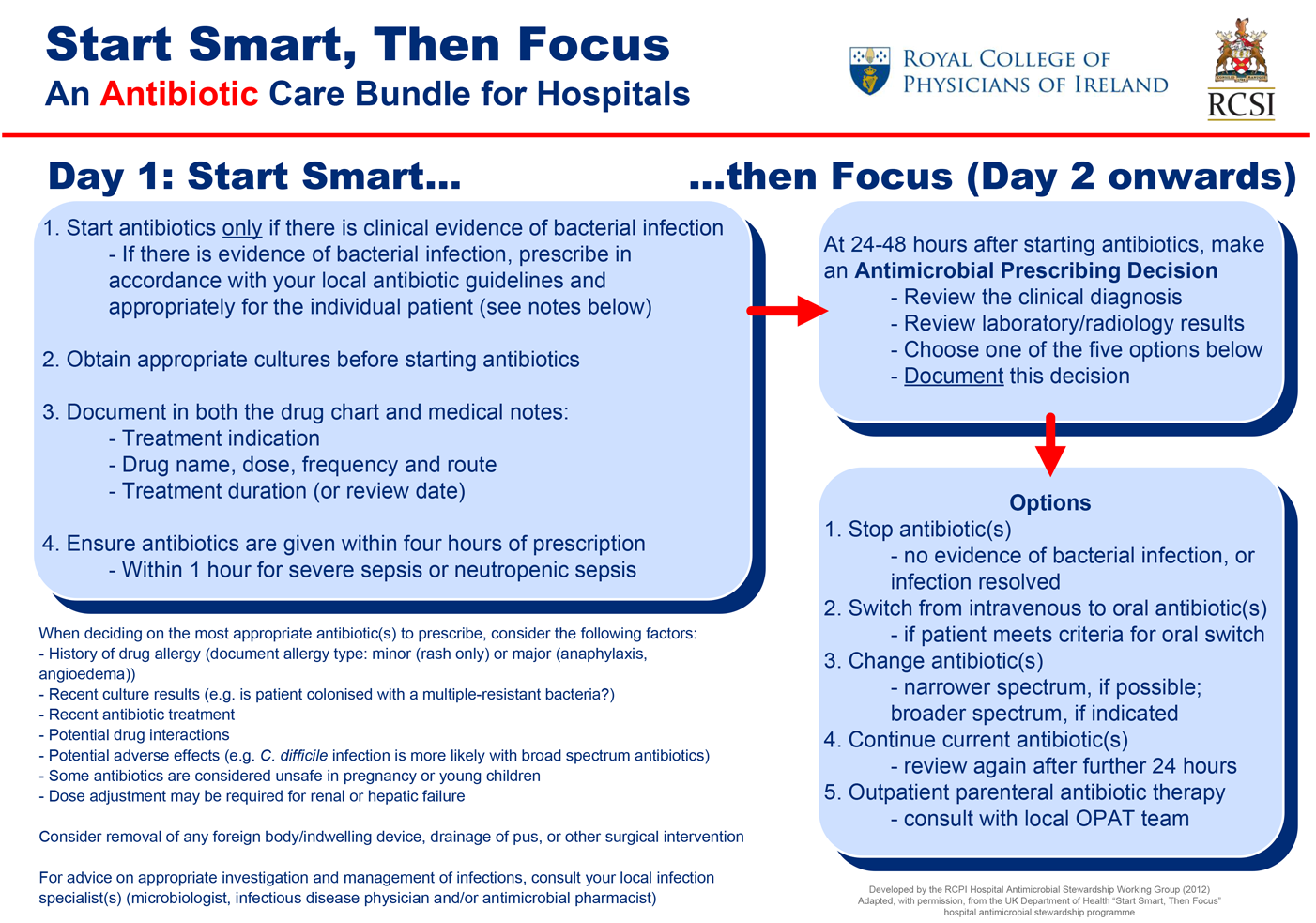
Start Smart, Then Focus Antibiotic Care Bundle
When prescribing antibiotics
all clinicans
should adhere to the following care bundle "
Start Smart - then focus
", developed by RCPI Hospital Antimicrobial Stewardship Working Group (2012).
Dosing in Obesity
The number of obese patients is increasing and standard doses of some drugs may not achieve effective serum concentrations. Data on antimicrobial dosing in the obese patient are gradually emerging, but only some drugs have been evaluated. Contact Pharmacy/Microbiologist (micro pharmacist bleep 640) re optimising antimicrobial dose in obese patients.
Topical Antibacterial Agents
|
Topical Antibacterial Agents (Note topical application of antimicrobials is generally not recommended - see below for LUH exceptions). |
||
|
Rationale for restricting use in hospitals |
The use of topical antibiotics freqently leads to the emergence of resistance . An infection that needs to be treated should generally be treated systemically. |
|
| Not routinely recommended |
Any topical antibacterial e.g. Bactroban ® Flamazine ® Fucidin ® Naseptin ® Polyfax ® |
|
|
Exceptions |
· Bactroban ® nasal ointment as first line treatment for MRSA decolonisation · Naseptin ® as second line treatment for MRSA decolonisation · Naseptin ® use by ENT · Topical antibacterial use by dermatology · Flamazine ® use by Plastics
|
|